Pinhole glasses: conical, cylindrical or pyramidal holes?

Myopic eye corrected with pinhole. The pinhole prevents the entry through the pupil of the most difficult to focus light rays. In this way the images are seen more clearly because they are deprived of the halo effect typical of visual defects.
What shape should the holes of pinhole glasses have?
This is the obsessive question that bounces on Amazon, hitting every retailer, even the Chinese ones.
Although it is always quite difficult to understand how the pinhole principle works, it seems that many are more worried with its shape. There are many theories, but in general everyone wants these glasses to have features. Not just holes, therefore, but holes of a certain kind.
These are the results of 30 years of persisting marketing.
So it happens that among the answers to the question: “How are the holes of these pinhole glasses: conical, cylindrical or pyramidal?” The Chinese retailer answers: “no” while other ones show more imagination: “conic-pyramidal shaped”.
The science fiction theory in favor of the conical hole, or rather, a truncated cone – with a wider opening on one side of the screen and narrower on the other – argue that this is better than a simple cylindrical hole. The conical shape would help to “channel the light”.
Unfortunately, light is not water.
Even more esoteric is the theory of the pyramidal hole: a square hole with a wider opening on one side and narrower on the other. The same principle as the cone, but we all know that the pyramid is magic, even the ancient Egyptians used to say it, and this adds some therapeutic quid.
There are pinhole glasses whose holes, checked with a large magnifying glass, actually have a non-cylindrical three-dimensional micro-shape. In particular, if the screen has been drilled with a punch machine, the entry side will be slightly wider than the exit side. How much? Very little. Here is how the truncated conical hole is born. On the other hand, many pinhole glasses with square holes have a thicker screen, because they are cut from sheets of pre-printed plastic for other purposes. In some cases it can be seen, even without a magnifying glass, that one side of the hole is wider than the other and the difference of the diameter between the two sides is … very little.
In both cases, from the point of view of the effectiveness of the pinhole glasses, nothing changes. The thickness of the screen on which the holes are drilled is almost zero. The difference in the diameter of the inlet and outlet holes is too small to have any effect whatsoever.
In short, the three-dimensionality of the hole does not matter. The plastic with which the screens are made is also almost always glossy: if the screen were thicker, and the hole had a consistent three-dimensionality, the light would reflect bouncing along the inner sides of the cylinder / truncated cone / trunk of a pyramid, creating an annoying halo effect. If this were the case, the truncated cone or the pyramid trunk would make the sight worse.
Going even more in detail, it is all to be verified whether pinhole glasses with “conic or pyramidal holes” are useful.
So, let’s check it out: just make a paper cone and cut off its tip and then place it in front of one eye. In general, even with a 5 cm long truncated cone or pyramid, there is not a big difference, whether you watch through the larger hole or the smaller one. In any case, the image is seen only through the smaller opening. To avoid splitting and blurring at the edges of the image, it is best to place the wider opening near the eye. In this case, however, it is confirmed that the conical or pyramid-shaped pinhole glasses are often builded on the wrong way, because most of the times they have the smallest opening on the inner side of the screens, that is the one closest to the eye.
To further improve the reliability of the experiment, the paper cone can be cut so that it less than half a centimeter long, still 50 times thicker than the screen of average pinhole glasses. Watching through any of the two sides it turns out that even in this case it is very difficult to perceive differences.
To add some mystery, I will reveal that there are pinhole glasses whose holes are star-shaped, and are also patented. What super power will the star hole ever have, compared to the common round hole? Even those who have patented it dont’ know. On the basis of the pinhole principle, it is a very bad idea.
To make it short, however, it is better to rely on photography, where the pinhole camera has been used for centuries and in a much more scientifically proven way. The hole in the diaphragm is round, not square, not triangular, not star-shaped. The slab on which it is made is as thin as possible, so the hole cannot even be defined as cylindrical . It only works that way, since Galileo’s time.
Even the myths about the arrangement of the holes are to be dispelled: the best is the honeycomb, that is an hexagonal pattern, for obvious mathematical reasons. The screen must be convex.
This doesn’t stop improvised sellers from telling a lot of nonsense about how their pinhole glasses are scientifically the best, just becauses the matter is so difficult that most of the people have no idea what they’re talking about.
If the screen is flat and has parallel strip holes, it probably means that it comes from a plate designed for other purposes and cheaper to buy, cut out and fit into a frame. This pinhole glasses are still usable and there are people who prefer them.
Cheap pinhole glasses are manufactured abroad, made in plastic that does not have any quality certification. The screens are made from flat sheets intended for other purposes. When the pinhole glasses are made properly the plastic si certified, the frames come from an eyewear factory and the screens are made with a lens mold, convex and modified for the holes. There is one screen for the right side of the frame and one for the left. In this case the price of the product is higher.
The risk of cheap pinhole glasses is that the holes of the two screens, being cut and assembled very quickly, are not symmetrical.
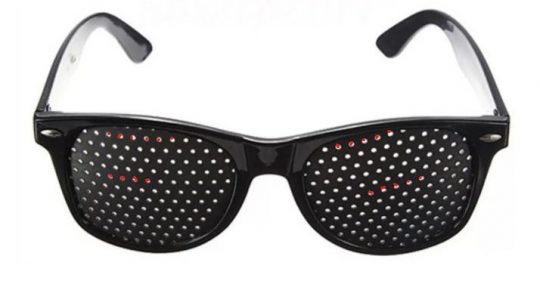
Cheap pinhole glasses made in Asian: uncertified plastics and random assembly of screens that are asymmetrical, probably causing discomfort to the wearer. The frame is the most common and characterizes the extremely cheap quality of the glasses, even in the case of more symmetrically arranged screens.
The diameter of the holes
Science is clear about, and photography confirms it: the narrower the hole, the more the focus increases. The wider it is, the more it decreases. There is a limit, however, which is related to usability. Usually good pinhole glasses are a a compromise between not too wide holes and their density. A screen with very small holes will allow a greater visual acuity but will require the presence of more light and greater skill in managing the device for tasks at close distance, such as reading. Larger holes will let in more light, but visual acuity will decrease accordingly. They may be fine to read if presbyopia is light, otherwise they are not enough to focus on writing and even from a distance they do not help much. People with a greater visual defect will be more confrotable with holes smaller than average.
Pinhole glasses with “bifocal” holes
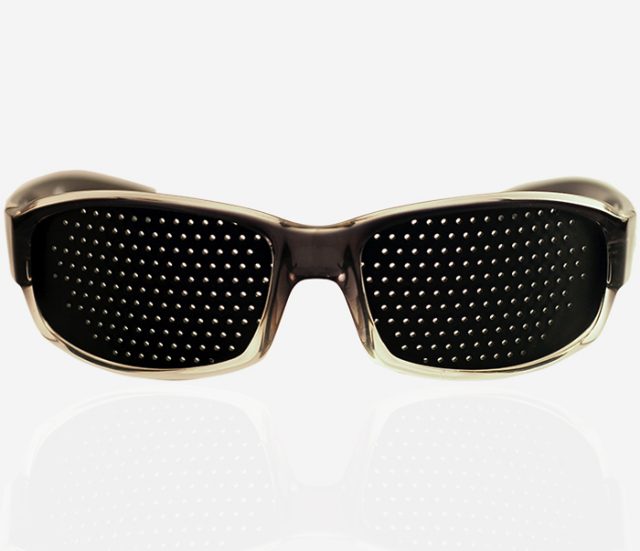
Those pinhole glasses that have smaller holes in the upper part of the screen and wider in the lower one, in imitation of traditional bifocal lenses, are a perverse invention, which only creates discomfort and visual confusion to their wearers. The better pinhole glassesare those with cylindrical (or pseudo-conical) holes with a honeycomb holes pattern and convex screens, (a good example is represented in the first image of this post). There is not much difference even with the square holes (pseudo-piramidals), there are people who prefer one to the other.
The “peripheral” view
When using pinhole glasses, the peripheral view is suppressed: with the corner of the eye, nothing can be seen. This is the reason why it is recommended to use them when stationary and in quiet places. To verify it, you can try to affix a small piece of non-transparent adhesive tape along the outer edges of the screen: not much changes.
Other “therapeutic” uses of pinhole glasses
For years they have been studied for their effects on posture, but there is nothing conclusive: in some cases they were almost miraculous, in others they did not have any effect. There are vendors who claim that they can also cure dandruff, but only their model: that of others is always very dangerous. Be wary of those who use this method of selling and be wary of those who wave statements of various “professionals”: looking at their websites it often turns out that they also sell other amenities that are part of their personal care system, which has no other demonstrable studies.
Want to learn more about?

Read the original post in Italian