Rorschach test on a sample of asylum seekers at Moria Camp in Lesvos
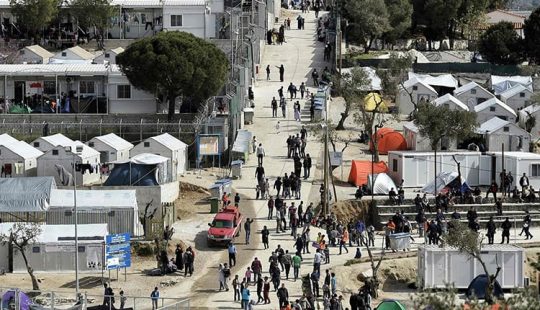
The migrant camp of Moria, on the Greek island of Lesvos, was established in 2015 to cope with the landings of migrants crossing the Aegean to reach Europe from the Turkish coast. Intended as an hotspot, it is equipped to accommodate up to 3,000 people for a short period of time, waiting for them to be processed. The situation has now become critical and in August 2019 the number of inhabitants of the camp has exceeded 11,000.
About 33% of the migrants are from Afghanistan and about 12% are from the Democratic Republic of Congo. Adult males make up about 40% of the total, 25% are females and 35% are minors. Of the minors, around 20% are unaccompanied and consist mainly of males.
The situation, as already written by many, is dramatic in many respects, not least the hygienic-sanitary and psychiatric ones.
During my stay in Lesvos, I worked with two accredited NGOs that provide free legal assistance to asylum seekers. As a clinical psychologist, I met clients sent by the lawyers or by the Protection Officers. The meetings took place in the presence of an interpreter.
The purpose of the consultations was mainly to obtain an indication of the psychological diagnosis to be added to the file for the interview with the Immigration Officer and/or to accelerate the taking charge of the patient by the local health facilities, in particular the vulnerable cases (psychiatric disorders, victims of torture, sexual violence…) not yet identified.
The cases I observed were predominantly adults from Afghanistan and from the D.R.C., with an almost equal percentage of males and females.
The consultations, lasting about an hour, were complicated by several factors:
– Unclear submission or limited understanding/misunderstanding by the assisted person as to the meeting context and purpose.
– Extreme environmental conditions: very high temperatures inside the container used as an office, very small spaces, conversations in other languages audible through the dividers.
– Difficulty in interpreting tones, gestures and mimicry of the assisted person, given the great cultural distance.
– Extremely low school attendance rates, with a high percentage of total illiteracy. Limited language and poor verbal skills.
– Interview broken and difficult to interpret due to the necessity of translation. In my case I already spoke a foreign language, English, which was translated into another language. In some cases the interpreter, although speaking the language of the assisted person, came from a completely different culture.
– Privacy reduced due to the presence of the interpreter, often from the same hotspot.
It was also necessary to distinguish between symptoms of chronic disorders and symptoms due to the generalized stress condition that almost all the patients showed, and that were related to the contingent situation: living in a crowded tent camp in which episodes of violence and discrimination are daily; lack of informations and cultural mediation; lack of adequate food and rest; bureaucratic limbo and uncertainty about the future.

Rorschach test images
Given the general situation, the Rorschach Test seemed to me a useful option to try to overcome some of the present difficulties, expecially the verbal one. Moreover, in its immediacy of short answers accompanied by images, it can illustrate the clinical case in a more effective and credible way than a simple written report – in a foreign language for the Greek officer – of a side psychologist.
The answers seemed to be largely genuine and their inclusion in the psychological report could be useful in order to receive more attention from the competent Greek authorities.
The main risk in using this test was its reliability, as it was administered to people from cultures other than Western Countries. In this regard I was unable to find relevant literature, and Rorschach Test in psychological consultations at the Moria Camp in Lesbos did not have precedents.
Because of the many variables which were difficult to control, I decided not to give a complete marking of the test, relying instead on the projective cues.
Other tests, like T.A.T., have been discarded due to their images being inextricably linked to Western culture and being often difficult to interpret for the subject (table 1 of T.A.T., for example, shows a child holding a violin, an instrument little-known by most of the subjects I met). The self-assessment tests were excluded because they would not be considered reliable by the authorities.
The Rorschach Test was administered to around 100 adults, equally divided between males and females, mainly Afghans and Congolese.
The first challenge was to find a comprehensible sentence to introduce the test to the clients: “A series of white sheets on which there are spots of color that can be interpreted at will” was the most used phrase, after having discussed it with the interpreters, but in many cases the client still believed that the task consisted of recognizing images that represented something real, and found themselves unable to give an answer. It was therefore often necessary to re-explain the purpose of the test and show an example image.
The intense shock to red colour, almost always interpreted as blood, as well as to black and white, was a widespread phenomenon. After the first interviews it was decided to advise some of the subjects in advance of the presence of these colors in the tables.
In general, the answers obtained were mostly single and global for each table. Frequent refused tables, in particular the II and IX.
—
The results of the Rorschach Test administered to the Afghans seemed to overlap with the western ones, with a rather high presence of movement responses for tables II and III. The most frequent answer to table I, was “moth” and to table V was “butterfly” or “bat”. The answer “wolves / lions / bears climbing a mountain” for table VIII were also frequent as were “marine animals” for table X.
Case 1: S.
Female, 26 years. Nationality: Afghan. Language: Farsi. Consultation requested by: her husband.
S. had lived in the camp with her husband and a 1.5-year-old daughter for about two months. The family fled from Afghanistan because of the relatives of F., who, not having approved the couple’s marriage, threatened to kill her husband to restore the family’s honor.
S.’s husband requested the intervention of a psychologist because he was worried about his wife’s mental health: he says she is aggressive with him and the daughter, and also with tent neighbors.
Report: “S. comes to this first interview elegantly dressed, with some light make-up and with a shy and composed attitude. She shows no signs of nervousness. Mimics and movements reduced to a minimum, according to her custom. She immediately begins by saying she does not recognize herself: she has become a nervous and aggressive person because of the uneasy situation in the camp. She can’t sleep well and has episodes of deep frustration during which she wants to find someone responsible for her current situation. Sometimes she feels it could be her husband, sometimes her daughter, sometimes herself. She does not seem to be fully aware of the bureaucratic process and the time required for her family’s asylum request: in her opinion everything has to be solved quickly by her husband, who had made many promises in order to marry her and now seems not to be able to handle the situation.
S. seems to have difficulty accepting her role as a mother and wife, regretting the position of protected daughter within her family of origin. The child cries if she walks away and this is not bearable for her at the moment. The husband seems to be in a position of subjection, because of his age (he is two years younger) and because of the premarital promises still to be fufilled and that his wife reminds him of every day.
According to S. the only possible solution is the immediate transfer from the Moria camp to a more suitable housing situation where she can relax. She declares herself incapable of protecting the child from her attacks of anger if the current situation persists. “
Rorschach test
I: Mask
II: People fighting. Blood.
III: People arguing over something
IV: Refused
V: Horror movie
VI: Sword piercing a body (upper detail: hilt)
VII: Fight
VIII: Wolves chasing something
IX: Refused
X: Refused
The family was subsequently followed by a social worker.
Case 2: F.
Male. Alleged years 16/18. Nationality: Afghan. Language: Farsi. Consultation requested by: lawyer assigned to the asylum request
F., who has been living at the camp since a couple of months, came to the meeting with a self-declaring uncle, who seemed worried about his mental health. With no documents on arrival, like many others present at the Moria camp, he did not seem to know his age exactly and claimed to be about 16 years old. On the document assigned to him by the Greek authorities the date of birth 1/1/2001 was inserted, a practice adopted to prevent young adults from exploiting the absence of documents to declare themselves minors, thus obtaining asylum and subsequently requesting family reunification.
Report: “I met F., a pale and very thin boy, today for the first time. He does not seem to know his exact age. He seems disoriented and scared, and his movements are very slow, almost catatonic. He continually checks the office, especially the corners , and stares at the people in the room (me and the interpreter). He blinks very rarely. Despite the high temperature of the room he does not sweat and breathes slowly and superficially. His eyes are shiny (lucor).
With a very weak and hesitant voice, he reports having severe heartburn. He has a diagnosis of reflux and hiatal hernia made by the medical unit inside the Moria camp. He says that it prevents him from sleeping, especially in certain positions.
He also reports some unclear symptoms regarding his head and throat. He seems very worried about his health, but does not seem to have a precise idea of the shape of his body and cannot indicate what hurts him. Frequent headaches with ophthalmic and olfactory aura. Not epilepsy. No reference to earlier physical traumas.
Every simple question scares him and it takes him a long time to come up with an answer, which is always very poor and expressed very slowly. His ideas regarding the present and the future are not very elaborate: he says he wants to go to Germany and bring his family from Afghanistan to reunite; he remembers to have been a good student at school, without any problems with memory or language, but that at some point his life has changed, although he cannot say why or how.
He often stops to check the room and the floor, staring at some points with a frightened expression. When I or the interpreter speak, he looks around and it seems that he needs time to identify who is speaking.”
Rorschach test
I: Shock. He stares at the table for a long time without blinking and looks scared. He looks around slowly. It takes time to recover.
II: Body parts. Stomach. Blood. Food that enters from here (lower detail of the image) because there is blood, and comes out of here (upper detail of the image).
III: Two people looking at each other. Throat bleeding (central red detail). Bleeding ears (red side details). Jaw (lower half of the image).
IV: Hips, ribs, neck. (global)
V: Hips
VI: Spinal cord
VII: Mouth (central white), shoulders, chest, collarbones.
VIII: Lungs (pink details)
IX: Refused
X: Body parts
In the case of F. I believe that the anwers to the Rorschach test, even before the written psychological report, were useful in ensuring that the case received more attention. With 11,000 people in a situation of distress, the requests for health care from the Moria Camp of Lesvos are continuous, not least from those hopeful of gaining some advantage. The Mytilene hospital, as well as the medical NGOs present on the island, are overloaded. Getting a medical examination at a Greek health facility (whose diagnosis is the only one that counts for the asylum request) is difficult for the less serious or the less evident cases.
—-
The administration of the Rorschach Test to patients from the Democratic Republic of Congo proved to be very difficult. In most cases it was impossible to administer the test due to the strong emotional reactions that this seemed to provoke, despite the initial explanation and the declared availability of the subject. Often it seemed to me that the client intended the table as a sort of symbolic message addressed to him personally and there were reactions of fear or offense, accompanied by phrases like: “Why are you doing this to me?”
The general tendency was to give the tables, when the client agreed to look at them, an emotional connotation focused on qualitative judgment, without further explanations or rationalizing mediations. “This is bad, it is evil”, or “This is scary”, “This brings bad luck”, “I can’t look at this”, “This reminds me of my past”, “This is better than that” .
Often the blue color was considered “good”, while black, gray, red and pink were always declared “bad”. Almost no movement responses. In no case was it possible to administer the complete test, and most of the responses were limited to “butterfly” or “bat” for Tables I and V.
Case 3: R.
Female. 42 years. Nationality: DRC. Language: french. Colsultation requested by: legal representative
R. was sent to me by the lawyer of the NGO: she was insisting that she was pregnant, but the doctors of the camp had already excluded it. She looked agitated and depressed.
Report: “I met R. today for the first time. She is elegantly dressed in traditional clothes. Her appearance is well-groomed. She writes her name with ease and in pleasant handwriting: she attended some years of school and belongs to a family that owned some land and money. A dispute between family members due to the division of a property ended tragically with the death of one of her step brothers and left her and her sister without possessions.
R. ran away leaving her children to a friend and said she had lost contact with them.
When she left her country she had the feeling of being pregnant. Now she calculates that the pregnancy is about seven months. She went to different doctors and pregnancy has been excluded. She shows me her abdomen, saying it is big: used to be flat before she left her country.
It is not clear if she has had her period during these last seven months, but it seems not. She says she had some spotting during her crossing on a dingy from Turkey, because she was “squeezed” among other people. She adds that at the camp she met a woman who explained to her that white doctors are unable to understand black poeple’s diseases.
She speaks of pregnancy, but never speaks of a future child and does not seem to believe that a life is growing inside her. When I ask her if she expects to have a baby in two months, she says no, because while she was leaving her country she was given a curse.
I ask her to tell me more about that feeling of being pregnant that she had at the beginning of her journey to Europe and she suddendly admits that she never had that feeling: maybe she is not pregnant, but in that case her abdomen must have something wrong and she would like more medical checks. “
Rorschach test
I: Bat
II: Gorillas fighting and pushing their hands against each other
III: Two women doing something, I don’t know what
IV: Refused. “Scary”.
V: Bat
VI: Refused. “Scary”.
VII: Heads of people (upper details)
VIII: Animals
IX: Refused. She turns the table and covers her eyes. She doesn’t want to explain why.
X: Refused
Case 4: K.
Female, age 35. Nationality: DRC. Language: french. Consultation requested by: NGO mobile medical unit
K., a beautyful woman dressed up with traditional and coloured clothes and very charming manners, comes to the interview showing a deep sadness. She speak in whispers and cry most of the time. Mother of three children, she says she had to leave her country because she was threatened with infibulation. She doesn’t know where her children are now. She says she was raped as a punishment for her refusal to be infibulated. HIV-positive.
Rorschach test
I: Refused
II: Blood. Someone has been tortured and blood is shed
III: Two people bent over, doing something
IV: Refused
V: Butterfly
VI: Refused
VII: Two fish that look at each other
VIII: Two mice. A big mouse with two small mice. The big mouse was killed, they did some surgical experiments on her.
IX: Fire
X: Heart undergone surgery. It was cut in the middle and some things were taken away.
K.’s case has been taken in charge by the Protection Officer.
—
Some of the NGO assistants, belonging to different nationalities, asked to take the Rorschach test as a curiosity and to better understand my interventions. Their results fall within the standards, but I noticed an aspect in common with the occupants of the camp: after an initial enthusiasm, which in the case of the assistants materialized itself in multiple responses and a participatory attitude, there was a sudden drop in productivity around table VI, after which a negative change of mood was evident together with a a certain fatigue on ending the test.
Given the context, I thought it could be a symptom of Burnout, a rather common problem for those working in the humanitarian field.
Other observations: the percentage of cases of epilepsy in the Third World is higher than that of industrialized countries and this was reflected by the cases in Moria camp.
Also N.E.S, Non Epileptic Seizures, i.e. non epileptic dissociative attacks, were widespread. The diagnosis of Post Traumatic Stress Disorder by doctors was very common, but in my opinion used in excess and therefore disqualified by immigration officers as a selection criterion. Although there were cases with objectively dramatic stories that occurred in the past or during the migration, many clients seemed more traumatized by the fact of discovering a Europe different from their expectations. In this regard, I noted a total lack of cultural mediation and the systematic dissemination of contradictory or false informations, that combined with prolonged uncertainty and social isolation can seriously compromise the emotional state of the most fragile subjects.
Many clients were used to taking psychiatric drugs from time to time, especially Depakin, which is an anti-epileptic. In many cases Depakin was taken not for epilepsy, but for the numbing effect. The demand for drugs of any kind was widespread, but their take up, even in cases of real necessity and precise prescription, was occasional and difficult to monitor. For this reason, although Sertraline is considered one of the most effective drugs in case of PTSD and can be purchased cheaply in Greece and without a prescription, it is rarley suggested. The patient often abandon the treatment because of its side effects, expecially the initial ones.
In Lesvos there are organizations that offer listening groups and classes like yoga, meditation, gardening, sewing, foreign languages, literacy, laboratories of manual activity, music, sport. Unfortunately there is a lack of collaboration between different organizations and many of them rely on non-professional short-term volunteering. I found it difficult to be constantly updated on what activities were actually carried on in order to suggest some of them to my patients and take them out of the camp at least for a few hours a day. I believe that in this regard there is a need for a unitary and professional project, better suited to the real needs of the recipients.
Rorschach test Wikipedia
Official migrants’ situation data in the Mediterranean